THORIUM
APPLICATIONS
 Contents
Industrial
Nuclear Reactors
Contents
Industrial
Nuclear Reactors
Chapter 2, Page 2:
Using
Thorium Nuclear Energy For In Situ Retorting and Recovery Of Shale Oil
< 1 Page 3 >
Categories:

Current estimates of the Green River
oil shale basin are about
1.5
TRILLION barrels of oil.
Our Endless Shale Oil

OUR
ENDLESS SHALE OIL
Download the slide show - (7 m pdf)

The United States has the largest reserves of shale oil in the world - about 1.5
trillion untouched barrels.
Untouched because the energy needed to extract this energy has always
been too expensive.
We now have almost free energy.
"For nearly a century, the oil shale in the western
United States has been considered as a substitute source for conventional crude
oil. But the economics of shale oil production have persistently remained behind
conventional oil. When crude oil prices were about $3 per barrel in the 1960s
and early 1970s, estimates of the required selling price needed to make oil
shale economic were about $6 per barrel. By the late 1970s, world crude oil
prices had increased to about $15 per barrel, but estimates of the required
selling price for oil shale had also sharply increased, ranging from a low of
$20 per barrel to a high of $26 per barrel (Merrow, 1978). Crude oil prices
jumped again in the winter of 1979–1980 in response to the Iranian crisis, and
so did estimates of the required selling price of shale oil, which were reported
at more than $45 per barrel in 1980 (OTA, Volume I, 1980).1
Once again, the United States is in a period during which
crude oil prices have risen sharply. As in the past, concerns are being raised
regarding the ability of world oil supplies to meet growing demands, especially
from the developing economies of Asia. Once again, oil shale is being examined
as a possible solution." - RAND M414
We now have the technology to economically extract our shale oil if we are brave
enough to use nuclear heat.
Shale oil is light "Tight Oil" - bituminous
materials tightly attached to shale rock that must be detached by heating.
Average estimated recovery of the Green River Formation is 800 billion barrels
- at 25% of US oil demand, would last 400 years. - - RAND_"MG-414"
About this site: The author has used this 2005
report:
http://www.rand.org/pubs/monographs/2005/RAND_MG414.pdf
(Above, about 90 Pages, 400 k download)
as a guide in designing the nuclear powered shale oil facility
suggested in this web site.
Pumpable Oil
Pumpable + Shale and Bitumen Oils

There are also
Synthetic
Oils made from feedstocks such as coal, natural gas, garbage, sewage, etc.
Our Shale Oil:
Here is the world's
largest oil shale formation: The Green River basin. It holds an
estimated 1.5 trillion barrels of shale oil.


Click on Pipeline Map to enlarge.

"Fracking" the shale
rock layer to free up the oil won't work.
Care must be taken to not contaminate the
river's aquifer system. The shale oil
(kerogen), located well below the aquifer and
under bad water, needs to be heated for two
years at 700°F or more to free it from the shale
rock. This calls for massive amounts of
hot heat. Once hot, and melted free, the
kerogen, now largely "cooked" into conventional
oil can be pumped like any other oil using
long-proven methods that won't damage the
aquifer. (American Shale Oil Co. sketch.)
Environmentalists, by blocking all
nuclear energy technology, are keeping our oil companies from extracting our shale oil.
The thorium-fueled molten
salt reactor,
a 1,300°F high-temperature nuclear reactor, is needed to supply the large
amounts of very cheap, very hot heat necessary to melt shale oil into a pumpable liquid.
Older type 550°F reactors are not hot enough.
Shale oil is the master
key to our nation's economic growth, and this small reactor is the key to shale oil.
Here is how a molten salt
reactor's heat can be used to extract shale oil.

Shale Oil
Extraction.
(Click on image to enlarge.)
The sketch above shows something new in the
entire history of modern manufacturing. Fire
is not used. Instead of fire, most of the energy used in this shale oil facility is being carried by heat
transfer salt rather than traditional steam or electricity. Salt, heated hot
enough to be a melted liquid like water, can carry heat almost as well as
water. The advantage to using heat transfer salt is that while it can
be hotter than steam (the
pipes are red hot), it
won't develop explosive steam pressures like water, making this a safer
facility. If the salt leaks, it cools and forms a solid lump rather
than dispersing into the environment. The down side is that, being
salt, it is corrosive. This means that expensive non-corrosive metals, such
as Hastelloy-N, must be used.
In the reactor sketch, above, radioactive fuel
is dissolved in a melted heat transfer salt called "FLiBe" and is circulated
by a pump between the reactor tank's graphite core (black) and four small
heat exchanger tanks located around the reactor tank. The radioactive fuel,
thorium, gets hot as the salt carries it through tubes drilled in the
reactor's graphite core. Leaving the reactor tank, the fuel salt then
passes through the heat exchangers and the salt's heat is transferred to a
second loop of non-radioactive "clear salt" which, in turn, carries the heat
out of the reactor's "radiation confinement cell" to the steam generator.
The steam from the steam generator is used to
heat the ground under the oil shale layer (stratum). This melts the shale
oil which is then pumped as ordinary oil.
During maintenance shut-down, the heat transfer salt must be drained into
the blue "drain tanks" to avoid going solid in the pipes when it cools. The
drain tanks have heaters to re-melt the salt and little pumps to put the
salt back into the pipes to re-start the facility. The same is true for the
reactor. If the reactor gets too hot, its salt melts a "freeze plug"
in the bottom of the reactor tank and the fuel salt drains down into drain
tanks. There, away from the graphite, the radioactive fuel can't
fission, so it begins to go cold and become solid.
A
million barrels of shale oil from one acre of
land is typical. A square of land about 6 acres
by 6 acres will keep this
120,000 barrels per day shale oil extraction
facility going for a year, producing a total of
44 million barrels of oil.
Hydrodesulfurization and hydrodenitrogenation treated shale
oil result in a product comparable to benchmark crude oil. Shale oil's
concentration of high-boiling point compounds is suited for the production
of middle distillates such as kerosene, jet fuel, and diesel fuel.
Additional cracking can create the lighter hydrocarbons used in gasoline.
Using natural gas
instead of thorium nuclear for steam
An environmentally clean process
using natural gas can be used to make the
extraction steam
instead of using thorium nuclear.
Far more expensive than thorium,
this process
incurs perhaps a 25% energy penalty to make the
combustion oxygen and to process the CO2 stream
into liquid.
Like the exhaust gas
recirculation valve in your car's engine, the
inert
flue gas recycle loop is used to dilute the oxygen
to keep the natural gas combustion under
control (no explosive fire).
This process can be put in place
today.
The author edited
a diagram originally made by
Air
Products to
show how their OxyFuel components can enable the
burning of natural gas
in an environmentally clean manner.
Also, click on logo to check out
Air Products'
 process.
The Bureau of Land Management
recently received ten applications (by eight
companies) for a pilot program to develop
Colorado’s shale reserves.
The program allows the companies access to
public lands for the purpose of testing
shale-extraction technologies. You see below an
interesting mix of large, publicly traded oil
giants and small, privately held
innovators.
OUR
ENDLESS SHALE OIL
Download the slide show - (7 m pdf)
________________________________________________________________________________________
Notes and Bibliography Links At Bottoms Of Individual Web Pages
●
To Site Contents
●
Contact
Author
●
Have
a nuke/oil/coal/gas question?
http://www.energyinfocenter.org/
●
________________________________________________________________________________________

EROI - Energy
Returned on Energy Invested. What energy is all about. One unit of energy spent
obtaining coal yields a payback of 80 units. Oil used to yield 38, today yields
12, and new oil discoveries perhaps 8. A very scary trend.
Canadian Bitumen tar sands yield 4, Ethanol from
corn slightly over 1. This is the cut-off point in energy. You can't
consume a barrel of oil to obtain a barrel of oil.
Shale oil promises to have a slightly better EROI
than tar sands.
What this chart shows us is the EROI of fossil fuels
obtained using fossil fuels.
It doesn't show what happens when you obtain a
fossil fuel using a nuclear fuel.

Why aren't we recovering our shale oil now like the
Canadians are harvesting their tar sands? In addition to having an EROI
that makes melting cold bitumen far less profitable than pumping oil, the
Canadians are trashing their environment.

Pumped oil has a very small environmental
footprint and, in many cases, environmentally sensitive oil companies have
proven to be the best of neighbors.
New economics make it compelling.
New technologies make it
possible.

Now, just when it appears pumped oil will remain
costly enough to justify extracting shale oil using expensive fossil fuels and
environmentally destructive old extraction methods, new technologies appear on
the scene that promise to make shale oil as cheap and as clean as pumped oil.
1. (Right, click.) The thorium-fueled molten salt
nuclear reactor. Has very little in common with today's reactors. Molten
salt reactors are 100 times more efficient and 100 times nuclear fuel cleaner
than today's water cooled reactors. Air cooling makes this reactor both safer
and easier on the environment.
2. Shell Oil Company has
developed and tested "In-situ" retorting methods that enable shale oil to be pumped as if
it were conventional oil. Easy on the environment. American Shale
Oil Company has a similar plan. If in-situ
retorting were heated by thorium instead of natural gas, it would be thousands
of times cheaper.
3. Shell Oil has also developed an "Ice Wall"
technology that protects aquifers located near the underground layers of shale
oil. It is unknown at this time if any salts or other substances would be
freed up by in-situ retorting and would eventually find their way into aquifers
after the ice wall was allowed to melt. Considering the small area
involved, 12 by 12 acres, and the size of the Colorado River basin, this may not
be an issue.
4. Heat transfer salt from a molten salt reactor
would enable environmentally clean splitting of water into hydrogen and oxygen.
Massive amounts of hydrogen are necessary to upgrade shale oil (Kerogen) into
gasoline, diesel, and jet fuel. Hydrogen obtained by splitting natural gas
is widely used today in oil refining for hydrocracking. Natural gas is both expensive
and a major source of carbon dioxide. Natural gas
CO2 from tar sands processing is the reason Canada had to leave the Kyoto
Accord.
5. Carbon dioxide capture and containment technology
in oil refineries is far more effective today. A nuclear powered oil
refinery promises to be far more environmentally-friendly than older oil
refineries.
Why is the molten salt reactor
the best choice for the oil industry?
The diagram at right shows the heat and power
characteristics for the various nuclear reactor families.
Coal boilers have been added by the author as the
black rectangle.
Molten salt reactors have been circled in yellow.
Hydrogen generation temperature and megaWatt energy
requirements have been indicated by green.
Neither the conventional Light Water Reactor nor the
Liquid Metal Fast Reactor are hot enough to replace coal heat. The Light
Water reactor and the Liquid Metal Fast Reactor have proven to be unexpectedly
expensive and not completely satisfactory.
The high temperature TRISO gas cooled reactor cannot
produce more than about 500 megaWatts thermal, too little for most oil
industry applications, and, being gas cooled, is large for its power.
This leaves the Molten Salt Reactor family.
They are
both hot enough and powerful enough to replace any fossil fuel boiler.
Only the single fluid converter type has been built
and tested for any length of time. Unlike the other reactor technologies,
molten salt reactors are designed to be passively safe and are the only reactor
type that will fail to a cold state. First developed to power
nuclear jet airplanes, MSRs exhibit a strong load following behavior (think
cruise control) due to the expansion and contraction of their radioactive fuel
salt. The single fluid converter can run as many as thirty years
continuously without having to be taken out of service for maintenance.
Because the fission actinides ("nuclear wastes") are
constantly being recirculated through the reactor core's neutron flux, they are
re-burned over and over down to their minimal state. This renders their
residual radioactivity extremely short-lived with 83% being safe within 10
years, all safe within 300 years. The mass of spent fuel is about 1/30th
that of a conventional reactor. This re-burning of the nuclear fuel gives
the reactor about 100 times the "uranium mileage" of a conventional reactor.
This is true regardless of which nuclear fuel, uranium, plutonium, or thorium,
the reactor is using.
MSRs must be started on fissile uranium or plutonium
but, once running, can be switched to far cheaper fertile thorium. Since
thorium is 4 times as abundant as uranium, does not need enrichment, and is
usually available in large volumes as a rare earth mine tailing, thorium is
literally "dirt cheap." The author has been counseled to suggest
a slightly more expensive fuel blend called "Denatured Uranium" which, it is
claimed, cannot be diverted by rogue states or terrorists.
MSR - Denatured -
CNSLeBlanc2010revised.pdf
Since MSRs run red hot and contain corrosive salts,
they are daunting devices to non-chemists unfamiliar with them.
It must be pointed out that while a 2.5 gigaWatts
(thermal) design is common in MSR
literature, the test unit built and run for five years by Oak Ridge National
Laboratories was only a 8 megaWatts (thermal) unit. It is the author's
opinion scale-up remote controlled prototype barges of 200 megaWatts (t) and 2.5 gigaWatts
(t) (both in the EBASCO 2.5 gW (t) confinement cell) are necessary and can be
realized within several years due to the simplicity and history of the
technologies involved.
Their extreme simplicity, combined with low initial
and running costs are their compensating features.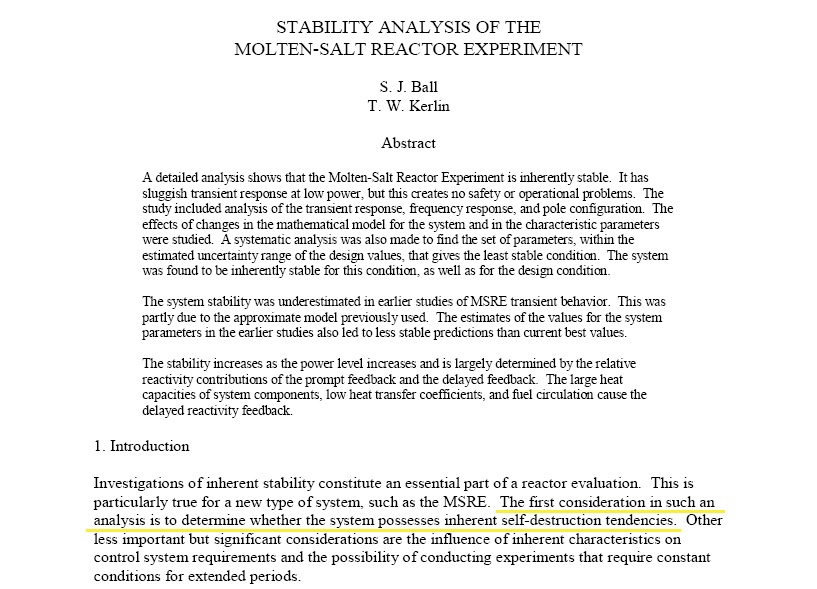
Stability
Click on the image at right to enlarge.
Download a
51 page
1.4 meg pdf copy of the report.
"Single
fluid MSRs are extremely stable, and will shut down [“throttle back”]
automatically if they overheat, due to fluid fuel expansion. For this reason
there is no reason for control rods, or reactor monitoring by operators."
"ORNL researchers preparing for the 1960's Molten Salt Reactor Experiment
determined that MSR operators would have nothing to do, and so would be bored.
They chose to design the MSRE without a control room, and ran the reactor
without an operator present."
Molten Salt Reactor Safety Related Advantages - Thursday, May 20, 2010
- Charles Barton -
http://nucleargreen.blogspot.com/2010/05/molten-salt-reactor-safety-related.html
More about thorium-fueled
molten salt reactors in Chapter 7,
Air-Cooled, Thorium-Fueled, Molten Salt Reactor.
How does the Shell In-Situ
Conversion Process work?

The diagram at right depicts the steps necessary to
obtain products from an oil shale deposit.

Shell In Situ Conversion Process
Very long heating rods and oil wells are intermingled.
(Image from RAND Report MG414)
15 to 25 heating holes per acre. They can be
either electrically or steam heated.
The heating rods are left on two or three
years until the shale oil is at 700°F. Then the shale oil can be pumped
and processed much like pumpable oil. This same heating process frees up a
very large amount of natural gas at the same time. An "Ice Wall" is frozen
around the heated area to protect the environment.
As you might expect, heating a several hundred foot thick layer of oil shale a
thousand feet under a 12 acre by 12 acre field takes a very large amount of
heat.
"This very slow heating to a relatively low
temperature (compared with the plus-900 degrees F temperatures common in surface
retorting) is sufficient to cause the chemical and physical changes required to
release oil from the shale. On an energy basis, about two-thirds of the
released product is liquid and one-third is a gas similar in composition to
natural gas. The released product is gathered in collection wells
positioned within the heated zone." - - RAND
Not only can oil companies see where the best
spots are using high resolution echo imaging, now they can get there with their directional drills, use
hydraulics to get some elbow room, and use as much thorium heat as necessary
to retort in-situ.
It's gonna happen!

The Shell test site.
The oil pump rocking beams are circled.
Notice the overburden of "Better Water Quality" above the
Illitic oil shale layer.
An ice wall down to the Mahogany zone, below, is needed to isolate the aquifer
from the extraction disturbances.

The "ice wall" in the ground to keep the environment
uncontaminated and to hold in the oil and gas as it is being freed up by
heating.
Ice walls are used for building foundation construction sites
in mushy ground. It
is unknown how well this will work on a large scale, decades-long recovery.

The
Chevron CRUSH process.
Chevron is considering a "Fracking"
fracturing approach and then blowing in heated carbon
dioxide to move the kerogen toward the production wells.
Supercritical liquid carbon dioxide is known to have
a solvent effect on tight oils, causing the oil to become free. Perhaps
the same is true for hot high pressure carbon dioxide gas. The high
pressure CO2 would probably blow free upon extraction and end up adding to the
Global Warming CO2 burden.
Externally generated hot gas - the Chevron CRUSH process.
Externally generated hot gas in
situ technologies would use hot gases heated above-ground and
then injected into the oil shale formation. The Chevron CRUSH
process, which was researched by Chevron Corporation in partnership
with Los Alamos National Laboratory, was designed to inject heated
carbon dioxide into the formation via drilled wells and to heat the
formation through a series of horizontal fractures through which the
gas would circulate. - Wikipedia
(The Chevron sketch shown above has no
hot air exit wells so cannot circulate heat through the underground
fractures to "cook" the kerogen into conventional pumpable oil.)
How cheap is
heat from thorium?
The cost of 1 million BTU
of heat in their common market units.
(In the United States,
February 2012.)
Oil
$18 per
million BTU (5.8 million BTU per barrel at $104 per barrel)
•Natural Gas
$5 per
million BTU (1 million BTU at $5 per 1,000 std ft^3)
Coal
$2 per
million BTU (30.8 million BTU per ton at $68 per ton)
•
Uranium
$0.92
per million BTU (Includes enrichment, fuel rod assembly)
•
Thorium*
$0.0000081
per million BTU (3.5x10^12 BTU/lb at $28 per lb)
•
*Approximate
Calculation
How much
heat from thorium is available?

The chart above shows where all the world's
energy comes from, the areas of the energies (center) represent their relative
amounts in heat. The flows show how the energies are being used.
"P" is conventional pumpable oil.
Your author added the thorium energy and non-conventional oils, "B" for bitumen
oil, "S" for shale oil, and "EH" for extra heavy oil (sludge).
Oil and M85 methanol can also be made economically by synthesis from coal, natural gas, and
biomass such as garbage, sewage, algae.
Click on the image for a downloadable pdf of a higher resolution printable copy.
Just look at all the energy we could get from
thorium.

(Below) Similar American Shale Oil
Company in situ concept. Red are steam lines, oil extraction lines are
green.
Test wells and echo imaging assure the shale oil holding strata are well-known.

(Below) Radio frequency heating.
Think microwave oven.


________________________________________________________________________________________
Bibliography: "Must Read"
Reference Sources below:

http://www.rand.org/pubs/monographs/2005/RAND_MG414.pdf
(Above, about 90 Pages, 400 k download)
http://www.rand.org/pubs/technical_reports/2008/RAND_TR580.pdf
(About 100 pages, 700 k download)
http://fossil.energy.gov/programs/reserves/publications/Pubs-NPR/40010-373.pdf
(Excellent brief, good Images)
http://oilshalegas.com/greenriveroilshale.html An excellent
what's there, who's there, web site to get you up to speed.
http://www.gastechno.com/
Natural gas-to-methane for "M85" vehicle fuel equipment manufacturer site.
This web site is about the
leveraging of thorium's almost free very hot heat. We would have a 1,300F molten
salt reactor - 2.5 gigaWatt (thermal or smaller) - running on thorium somewhere
in the remote Green River shale oil basin. Some of the reactor's heat would be
used to drive a sulfur-iodine water splitter to make large volumes of hydrogen
for upgrading kerogen to gasoline, diesel, and jet fuel. The reactor would
also be driving a Stirling hot air electricity generating turbine to power the
entire remote shale oil facility. Using heat from the reactor, both shale's
kerogen and some methane (natural gas) would be extracted. The methane could be converted to liquid
vehicle M85 fuel by using Gastechno type equipment or both liquids could be
further upgraded and refined into vehicle ready fuels.
The refinery would be completely
"Greenhouse Gas" clean, i.e., nothing would be burned to make electricity.
CO2, H2S, and other waste streams would remain captured and
disposed of properly.
________________________________________________________________________________________
Unconventional Oil
http://en.wikipedia.org/wiki/Mitigation_of_peak_oil
Mitigation of peak oil.
http://ostseis.anl.gov/guide/links/index.cfm
http://www.fossil.energy.gov/programs/reserves/publications/Pubs-NPR/40010-373.pdf
Is Oil Shale America's Answer to Peak Oil?
http://www.fossil.energy.gov/programs/reserves/npr/NSURM_Documentation.pdf
National Strategic Unconventional Resource Model
http://news.upc.edu.cn/english/
China University of Petroleum
http://en.wikipedia.org/wiki/Stuart_Oil_Shale_Project near Gladstone,
Queensland, Australia.
Methanol M85
http://www.methanol.org/
http://www.openfuelstandard.org/2011/05/what-does-open-fuel-standard-act.html
________________________________________________________________________________________