 Site Map
Page 2 >
Site Map
Page 2
>
What Is Thorium?
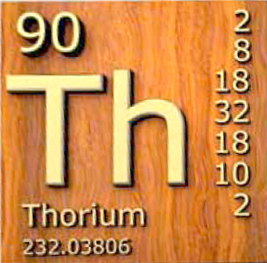
What Is Thorium?
There are two natural energy metals: Uranium and Thorium.
General information about thorium:
http://en.wikipedia.org/wiki/Thorium Monazite Ore
Let's begin with the most difficult concept first.
The Nuclear Path Not Taken. The Manhattan Project identified 3 viable nuclear energy paths: Uranium, Plutonium, and Thorium. Thorium had near-zero military potential and was subsequently abandoned and forgotten.
How near-zero? As desperate as both the Allies and the Axis were to obtain atomic bomb materials, neither side apparently gave plentiful thorium a second thought.
Thorium is slightly radioactive. It has to be converted into more radioactive uranium-233 by adding one more neutron to it's nucleus before it is radioactive enough to make heat in a reactor. A diagram showing the process is shown below. Thorium's conversion process takes 27 days. Not important in a reactor that runs on a 30 year cycle.
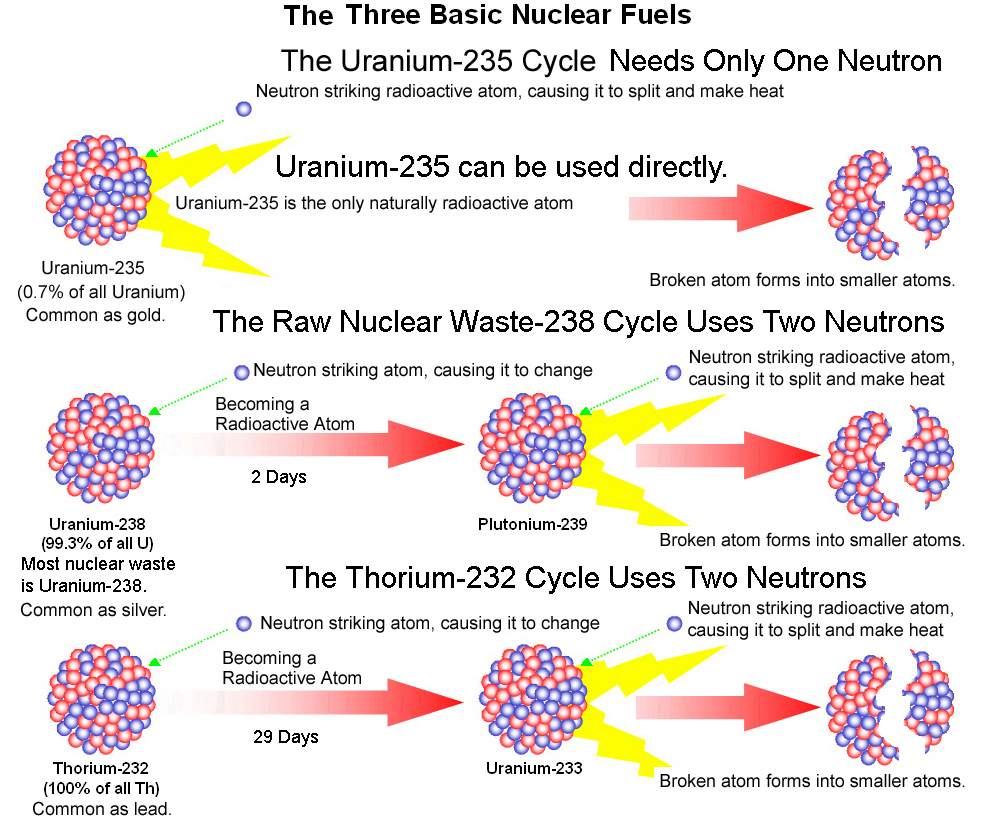
Thorium's conversion process in a reactor. This is a natural process that goes on continuously as the reactor runs. A few neutrons are lost in the process. That's why an average of 2 1/2 neutrons are necessary to keep the process running.

How much energy can we obtain from thorium?
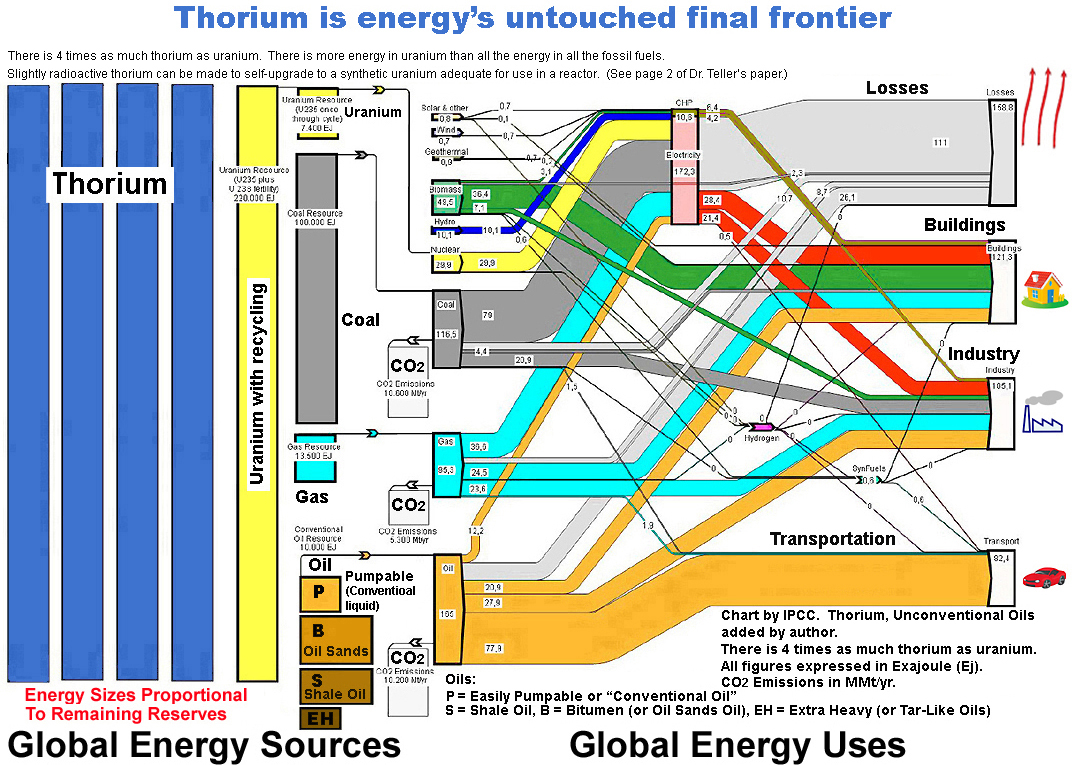
The chart above shows where all the world's
energy comes from, the areas of the energies (center) represent their relative
amounts in heat. The flows show how the energies are being used.
"P" is conventional pumpable oil.
Your author added the thorium energy and non-conventional oils, "B" for bitumen
oil, "S" for shale oil, and "EH" for extra heavy oil (sludge).
Oil and M85 methanol can also be made economically by synthesis from coal, natural gas, and
biomass such as garbage, sewage, algae.
Click on the image for a downloadable pdf of a higher resolution printable copy.
Just look at all the energy we could get from thorium.
How does thorium compare with uranium in a reactor?
Comparing a Thorium reactor's fuel use and waste with a Conventional Uranium reactor of the same power. This illustrates the far better "fuel mileage" and far less nuclear waste of a Thorium reactor.

________________________________________________________________________________________
Current conventional reactor technology is proving to be both
unacceptably expensive and apparently has safety issues that cannot be engineered away.
China has a high-priority formal development program for this reactor. Molten Salt Reactors (MSRs) have almost nothing in common with conventional reactors, promise to be far cheaper and easier to make and run, go cold when shut down, use an energy metal that requires no expensive enrichment, and produces 1% the nuclear waste of conventional reactors, most of what waste there is is unsafe for less than ten years and none of it has any military value.
Developed by nuclear chemists, molten salt reactors naturally run red-hot at 1,300°F and use unpressurized melted salt carrying dissolved nuclear fuel circulating like blood through the reactor and its heat exchangers, daunting characteristics in the eyes of the typical nuclear mechanical engineer trained on 550°F, solid fuel, high pressure conventional reactors.
Unpressurized means it cannot explode. If any radioactive molten salt leaked out, it would turn solid when it cooled and, unlike radioactive water from a nuclear power plant, cannot sink into the ground and then disperse into the environment. You would locate any leaked material with a Geiger counter then retrieve it with a long handled shovel.
________________________________________________________________________________________
Origins of the fluid-fuel nuclear reactor
The applications described on this web site are for a "new" old
reactor that was developed at Oak Ridge National Laboratories and then put on
the shelf and forgotten. This reactor was to be the Air Force's equivalent
to the Navy's nuclear submarine reactor. Yes, it was a nuclear reactor
designed to power two or more nuclear jet engines in a nuclear bomber.
Several "proof of performance" versions of the airplane reactor were built by
Pratt & Whitney and General Electric.
Oak Ridge National Laboratories and then put on
the shelf and forgotten. This reactor was to be the Air Force's equivalent
to the Navy's nuclear submarine reactor. Yes, it was a nuclear reactor
designed to power two or more nuclear jet engines in a nuclear bomber.
Several "proof of performance" versions of the airplane reactor were built by
Pratt & Whitney and General Electric.
(Photographs: Above, MSRE reactor on display at Oak Ridge National Laboratories. (Right), Proof-of-performance prototype of Pratt & Whitney jet engine reactor at Idaho National Laboratories. The work of 14,000 people and a billion Air Force dollars (The Nuclear Energy Propulsion for Airplanes project.) sitting beside Idaho National Laboratory's Visitor Center parking lot.
The "Molten Salt Reactor Experiment" reactor was built and run for 5 years at the ORNL facility that developed the airplane versions. The MSRE version was 8 megaWatts thermal in power. It ran as expected on every nuclear fuel including nuclear waste. Starting it on uranium and then running it on thorium proved to be an excellent combination providing unbelievable fuel economy and producing almost no nuclear waste with near-zero weapons potential.
How cheap? $300 million dollars worth of coal or $50,000 worth of thorium will produce the same amount of heat. That's 6,000 times cheaper. How can this be? There is 4 times as much thorium as uranium, unlike uranium, thorium does not need costly nuclear fuel enriching - you just use it - and a molten salt reactor gets about 100 times the thorium mileage as a conventional reactor gets uranium mileage.
The MSR on this web site is unpressurized, so it can't explode. This also means it can be made of far thinner metal than a conventional reactor. That should make it much cheaper to build and safer to be around. Also, if it gets into trouble, it goes cold naturally - it is convection air cooled so it doesn't need any shut-down power. No other type of reactor can make that claim.
________________________________________________________________________________________
Their Applications As Described In
This Web Site
MSRs appear to be well-suited for the supremely important task of replacing coal, natural gas, and oil.
Repowering coal burning power plants
Because of it's much higher temperature (1,300°F) than conventional
high-pressure water cooled reactors (550°F) and its unpressurized red-hot heat
transfer salt cooling system, by simply replacing a power plant's fossil fuel
boiler with a thorium boiler, a coal power
plant would become 100% environmentally clean at very low cost.
Hydrogen generation In addition, with a little help from some heat booster Calrods, MSRs can open the doors to the hydrogen economy by powering the sulfur-iodine water splitting process developed about a decade ago by General Atomics. The hydrogen produced would greatly reduce the cost of refining crude oil into gasoline.
Repowering combined cycle jet turbine power plants Its jet engine roots also make it a wonderful candidate for Global Warming-free repowering of today's gas turbine generators in combined-cycle power plants.
Oil extraction from shale and oil sands Shale oil and oil sands bitumen are "Tight Oils" that need to be melted free from the rocks that hold them before they can be pumped. Combined, the United States and Canada hold over twice the tight oil man has already pumped.
Synthetic vehicle fuels Gasoline from garbage and sewage become both environmentally and economically practical feedstocks for vehicle fuel when using a high temperature MSR to power plasma torches to gasify the feedstock, to power a small water splitter to make the needed hydrogen for hydrocracking, and also to power a gas-to-liquids synthesis refinery. Carbon capture technology can also recycle what used to be the refinery's CO2 emissions into vehicle fuel feedstock if ample hydrogen for hydrocracking is available.
Replacing all stationary fossil fuel fires The applications cited here are the world's biggest users of fossil fuels and are a good heat, power, and physical match for the 70' in diameter, 50' high EBASCO molten salt reactor, a 2,500 megaWatt (thermal) 1,000 megaWatt (electrical) reactor that was detail designed by EBASCO for ORNL but never built. There are smaller 1,000°F reactors such as the 25 megaWatt (electrical) Gen4 energy's reactor, (A well-respected Russian submarine "fast" reactor currently in advanced development for civilian applications in the US.) that will do a better job of replacing fossil fuels for the world's several million general industrial and boilers and furnaces. Once 25 megaWatt (e) reactors actually appear in the energy marketplace, smaller, perhaps as small as 5 megaWatt (thermal), reactors are sure to follow. World wide, there are perhaps 500 million fossil fuel boilers and furnaces in this industrial, commercial, and institutional power range.
________________________________________________________________________________________
1-2
Thorium's Almost Free Energy, The Molten Salt Reactor's Costly Reactor Salt
1-4 Reactors
101 - A User's Buying Guide. All The Different Reactor Types On A Single Simple,
Easy to Understand, Diagram
HOW THE REACTOR WORKS
1-6 Safety
Advantages
1-9
International Atomic Energy Agency (IAEA) And Thorium Reactor Development
1-10
1-11 Thorium-Active
Companies, Universities, Institutions, and Web Sites Advocating Thorium Reactors
1-12