 Map
Map
CHEAP GASOLINE !
Map
What would a mass-market
nuclear basement hot water heater be like?

Contents
of this page
1)
2)
3)
4)
5)
Appended Earlier Web Page - Many Broken Links
A REACTOR TO REPLACE COAL
BOILERS
The purpose of this page is to define what a nuclear
boiler must be to replace a coal burning boiler.
A spectrum of high
temperature
reactor sizes is nuclear's only hope of ever becoming anything more than a niche
energy source.
The
"MASS MARKET" thorium reactor:
If nuclear is to replace coal, gas,
and oil, it must be as easy and as safe to use as coal, gas, and oil.
Nuclear medicine is everywhere, nuclear heat can - and should - be everywhere
also.
N
needs to be made "convenient enough"
INTRODUCTION: "Open-Source" like "Open Office," Linux, and much copied machines.
The Goal: A nuclear boiler that can replace coal and gas boilers.
________________________________________________________________________________________
INTRODUCTION: "Open-Source" like "Open Office," Linux, and much copied
machines.
________________________________________________________________________________________
The
Goal: A nuclear boiler that can replace coal and gas boilers.
The Goal:
A nuclear boiler that can replace coal and gas boilers.
Economics and
applications suggest a 1,000 megaWatt (e) Molten Salt Reactor should be first.
Why a one-size-fits all converter, not
breeder, reactor makes the most sense for the application before us.
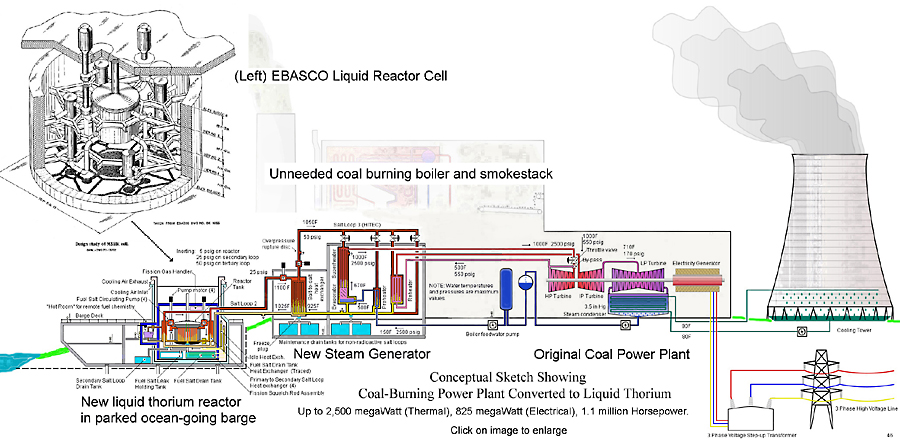
The electricity
generator's turbine (red) is disconnected from the coal burning boiler (center,
lifted, faded), then reconnected to the nuclear boiler.
Key novel features: Transportable modular reactor.
Steam generators not integrated with reactor. No pressurized vessels - only the
steam pipes are pressurized.
Molten Salt heat transfer makes driving multiple steam generator sets from a
single reactor practical.
________________________________________________________________________________________
Summary: 8 modern advances beyond your father's reactor.

(Right) From Hyperion. A Hyperion
nuclear power module in a low tech user environment.
http://www.hyperionpowergeneration.com/
Advance 1. Hot enough to compete successfully with coal, natural gas or oil heat. This reactor runs at about 1,300 degrees Fahrenheit instead of the 550 degrees F typical of older water-cooled reactors. This enables nuclear reactors to compete with coal fire's ability to produce practical superheated steam.
________________________________________________________________________________________
In m
In m
Why the author thinks the molten salt nuclear boiler has the "Right Stuff" to replace coal.
The 1,300°F promised by the Molten Salt Reactor (MSR) - LFTR folks is hot enough to be beyond question but the somewhat lower temperatures of the 910°F liquid metal cooled Integral Fast Reactors (IFR) is clearly cause for concern since the superheated steam is at least 90°F cooler than the GE turbine's original design. The Westinghouse type water cooled reactor was added for reference purposes.
(If you have candidate boiler and can get the government to expense the engineering costs of an emissions feasibility study, the author knows of a utility engineering firm that's looking for work.)
Coal, Molten Salt Reactor, Integral Fast Reactor, and Conventional Nuclear boilers
Steam compatibilities. Using the world's largest supersized coal plant, Taichung, as a very typical example. For one of Taichung's 550 megaWatt (e) boilers, mass flow would be about 3,187,000 pounds of water per hour at 2,524 psig, 1,005°F, and 550 psig high pressure turbine discharge.
Reactor examples: The Russian Rosatom "BN-800" Sodium Fast Reactor, the EBASCO Molten Salt Reactor
Replacing coal
boilers with nuclear heated boilers.
(The
high temperature (1,300°F molten salt reactors are far better suited for
coal replacement applications than are the older, far less fuel efficient,
and cooler common reactors. The BN-800 mentioned here is a
commercial Russian product. The EBASCO was designed but never built.)
COAL
1,300°F MOLTEN SALT REACTOR
These steam values are conventional sub-critical superheated steam technology. According to the IEA, supercritical status for hard coal plants is defined as achieving outlet steam temperatures of 540-566 °C (1,000-1,050 °F) and a pressure of 250 bar (3,600 psi). Ultra-supercritical units are defined as those with outlet steam temperatures above 590 °C (1,100°F) and pressures above 250 bar (3,600 psi). Supercritical and ultrasupercritical plants can achieve efficiencies of over 45%; conventional sub-critical superheated steam plants rarely achieve thermal efficiencies of 40%.
Very few new large power plants are being built for anything other than the more efficient 1,050°F supercritical steam. At 1,300°F, the thorium molten salt reactor has a long future.
________________________________________________________________________________________
Fuel Considerations
A 1,000 megaWatt (e) reactor designed for a core discharge temperature of 750°C (1,380°F) and an 85% capacity factor, this type of reactor's radioactive fuel is dissolved in hot unpressurized liquid salt that functions as the reactor's coolant. It is a reactor that uses nuclear graphite as its moderator. It can run on uranium, thorium, or plutonium.

(Right, from Dr. Robert Hargraves' "Aim High" Google lecture.)
Right, above, the starting fissile load and resulting fission products of a conventional solid fuel reactor.
Right, below, the starting fuel load and resulting fission products of a liquid fuel Fluoride reactor.
Take 2: (Following paragraph from Dr. David LeBlanc's Google lecture.)
Starting Fissile Material Loads: One major advantage is that while conventional PWR reactors are not too bad - say, 60 million dollars worth of fuel rods, compared with other advanced reactors such as the Sodium Cooled Fast (12 tons) and the Lead Cooled Fast (20 tons) the "Converter" Molten Salt Reactors takes only 1 1/2 ton (1,500 kg) - a much smaller initial starting load of radioactive materials to get under way. Once up and running, 800 kg per gigaWatt-year (e) thorium consumption - costing about 50,000 dollars a year to make about 500 million dollars of electricity - has been stated by Dr. David LeBlanc, Physics Department, Carleton University, Ottawa, in a Google talk on Feb 19, 2009.
The entire U.S. supply of plutonium from spent fuel and weapons programs could only start 30 to 40 Sodium or Lead cooled fast reactors - and we need thousands to impact Global Warming.
Introducing the New Small Modular Reactors (SMRs)
Deep Pockets No Longer A Prerequisite.
A few of
the new small mass-produceable r
Militaries and Space Agencies around the world have
produced portable nuclear reactors as small as
backyard grille propane tanks.
A common theme for this generation of more practical reactors is to simply place
them in underground silos for radiation containment and physical safety.
Red
designates reactors on
The power of price will enable thousands of small
electricity companies, colleges, industrial and commercial users to move up to
clean nuclear energy.
Platts Small Modular Reactor Meeting .pdf
Small Modular Reactors - NEI Position Paper .pdf
mPower - TVA wants 6 SMRs .pdf
"Ferrara said B&W has a cost target
of $4,000/KW for its new SMR. Two potential customers are TVA and First Energy.
Last July TVA said it is interested in the mPower reactor and pledged support
for the licensing process. An executive with First Energy told FCW that the
firm is providing user requirements to B&W.
Designers Tout Safety Of Small
Modular Reactors At Conference.
Platts (5/24, Freebairn) reports, "Small modular reactors are less vulnerable to
some types of accidents," including complete loss of power accidents like those
at Japan's Fukushima plant, said "potential manufacturers of the new reactor
designs [at] Platts Small Modular Reactors conference Monday." NuScale
Power's chief marketing officer Bruce Landrey said his company's 45-MW modular
units have "no reactor coolant pumps because they rely on natural circulation
for emergency cooling." Landrey said a NuScale analysis shows its unit "does not
need an external supply of water or any power to maintain cooling," because it
rests "inside an area flooded with 4 million gallons of water that can be used
for cooling, he said." Babcock & Wilcox exec Jeffrey Halfinger said their 125-MW
"mPower" concept would also use "passive cooling," but as a last resort, after
multiple other stages of backup cooling systems are exhausted.
http://en.wikipedia.org/wiki/Hydrogen_Moderated_Self-regulating_Nuclear_Power_Module
Dr. Peterson's original reactor.
http://en.wikipedia.org/wiki/List_of_small_nuclear_reactor_designs List of
small nuclear reactor designs.
THORIUM instead of URANIUM:
www.nucleartownhall.com Interview:
Thorium Proponent Kirk Sorenson .pdf
Sealed away from users,
usually in an underground silo. - No nuclear knowledge
needed to obtain or use a nuclear boiler.
Nuclear fuel rods, when thermally cold, can be safely handled with bare hands.
Nuclear fuel rods, when so radioactive they are thermally hot, produces neutron radiation capable of going through as much as six feet of water. Humans are mostly water. Radiation this intense can kill humans.
This source of radiation must be kept away from humans. The best containment design appears to be to keep the reactor's core in an underground concrete vault with walls thicker than 3 feet. Reinforced concrete is cheap and very tough. We make roads out of it. Being in an underground vault, ground moisture acts as water, stopping neutrons in a very short distance.
Hyperion
Power Module
http://www.hyperionpowergeneration.com/
http://en.wikipedia.org/wiki/Hyperion_Power_Generation

(Right) The 1,000°F Hyperion 25 megaWatt (e) 10-year lead-bismuth fast-neutron reactor is the closest to a "Boiler License Accessible" general-consumer industrial reactor on the market so far.
(Yellow circle) The Hyperion has dual truck serviceable reactor silos - one for active, one for cool-down. Notice the reactor silos are located outside the power plant.
A semi-trailer pulls over the cooled down reactor silo and hoists spent reactor up into the trailer, then a factory-fresh reactor is lowered and eventually connected to the steam generators.
Toshiba 4S

(Right) The 30-year 10 and 50 megaWatt (e) Toshiba 4S is also in the running.
The Toshiba 4S reactor for Galena, Alaska, has its core almost 90 feet into the ground.
The Toshiba 4S is intended to be replaced every 30 years with a fresh core. In the case of Galena, Alaska, located on the Yukon River, it would be withdrawn from the its silo, placed on an ocean-going barge and returned to Japan.
Nuclear isn't just for electricity anymore
Many companies will soon be offering small "hot tub" modular nuclear "heat batteries" to replace coal and natural gas burning boilers. Depending on the model, every 5 to 30 years you swap it out for a fresh one.
Reasonably priced,
automatic and

Or, you could hook an
electricity generator to it and have a small nuclear power plant to power a
small town.
< Hyperion reactor Gas boiler >
(Hyperion calls it a "Power
Module.")
http://www.hyperionpowergeneration.com/

Replacing natural gas applications
are where tiny nuclear boilers will find their niche. Burning natural gas for
heat is stupid when you consider you can easily turn it into gasoline. See
By replacing natural gas, you end
the CO2 natural gas makes - about 2/3 as much as coal.
See:
CO2 emissions from various fuels - Pounds per kWh - EPA .pdf

Certainly not nuclear cars, but it is very likely that apartments, offices, schools, hospitals, government buildings, military bases, and large airport terminals will all be heated, cooled, and electrically powered by these hot tub-sized reactors located in underground silos beneath basements and boiler houses.
China is talking about doing exactly this in over 1,000 locations.
A Repackaged
Nuclear Technology. Completely Automatic Operation.
It doesn't get any more "Hands Off" than this Hyperion reactor application.
The Hyperion is designed to run full power for 10 years between trips back to
the factory for refueling.
The Toshiba 4S reactor intended for Galena, Alaska, is designed to be buried in a 90 foot deep silo and go untouched for thirty years.
If this surprises you, recall that our nuclear submarines have a single desk-size nuclear reactor core and there is no way to refuel or replace it. Those reactors can provide full power for more than the 30 year operational life of the ship. The fact there is only one reactor speaks volumes about what our Navy has learned about reactor reliability in over 50 years of use.
Our nuclear navy sailors spend months at a time sealed up under water within a few feet of the reactor.
Bringing power plant radiation standards up to nuclear medicine radiation standards.
SRNL Partners With Universities,
Labs To Form Radioecology Center.
The Aiken (SC) Standard (1/28, Dolianitis) reports, "Radioecology experts at the
Savannah River National Laboratory have partnered with universities and
laboratories from across the United States, as well as France and the Ukraine,
to form the National Center for Radioecology (NCoRE), a network of expertise in
environmental radiation risk reduction and remediation." The program aims "to
work with key partners to establish a training and education program for
radioecologists to develop future capability as the existing pool of experts
reaches retirement age, and to serve as faculty for courses offered at some of
the partner universities." Wendy Kuhne of SRNL, one of the lead researchers for
NCoRE, said, "The growth in new nuclear energy capacity is going to require the
ability to realistically assess the health and environmental impacts of nuclear
facilities."
Example of
passive cool-down.
(Right) GE-Hitachi PRISM fast
neutron reactor passive auxiliary cooling system. Cool air (blue), drawn in by
the air heated by the reactor (red) creates a natural, unpowered, reactor core
cooling system.
Something SMALL is happening.
Local nuclear to keep our small towns and villages sustainable. Remember when
millions of microcomputers popped up alongside huge mainframe computers? Well,
it's déjà vu time all over again!
This time it's SMALL, LOW COST nuclear boilers instead of your father's huge
costly "mainframe" nuclear reactors.
The Russians are delivering on what our government promised, then failed to deliver: Spent Nuclear Fuel Takeback.
Russia's Spent Nuclear Fuel take back offer.

A Wiser "Spent Nuclear Fuels" Policy


Atoms for Peace .pdf
President Eisenhower's good 1953 American idea that Jimmy
Carter trashed in 1977.
Now, 30 years later, the world has stepped in to restore it.
Think of how much Global Warming Jimmy Carter caused by delaying nuclear and
turning the United States into a nuclear backwater country.
Russian state nuclear energy company Rosatom said
that it had completed arrangements for the fuel store in the vault of the
International Enrichment Centre at Angarsk. It will be managed under the
auspices of the IAEA.
http://www.iaea.org/
(Author’s Opinion)
No old, cold, spent fuel rod storage anywhere.
If there isn’t 6 feet of water between you and a spent fuel rod fresh out of
a running reactor, you’re dead pronto.
Spent fuel rods contain a mix of plutonium 239 (great for making bombs) and
plutonium 240 (makes bombs go off prematurely).
Some day, someone is going to figure out how to separate those two isotopes
(we tried, we failed).
The Russians are planning to snatch back and recycle the spent fuel rods
from their reactors while they are still unsafe for untrustworthy hands to
handle.
This completely changes the costly nuclear power plant decommissioning issue. By hauling the reactor away, we have a disposable recyclable reactor and no residual radioactivity at the user's plant site.
Disposable Reactors -
Taken away when no longer needed.
(Below) The author's idea for a 1,000 mWe Model "T" reactor mounted on a concrete ocean-going barge. Many of the largest coal burning power plants are located on navigable water for access to coal barges and cooling water. The idea is to cut a shallow temporary channel from the water adjacent to the power plant to a location in the coal storage yard near the power plant's turbine gallery.
When the reactor is worn out in 30 years or so years, the channel would be re-opened and the reactor barge hauled away for disposal.


The Russians are putting entire small power plants on barges and hauling them to the Arctic to power remote Siberian Cities.
Nuclear electricity barges such as the one depicted here also typically will have desalinators to provide drinking water to the cities they are powering.
15 Countries have expressed interest in leasing these barges.
http://en.wikipedia.org/wiki/Russian_floating_nuclear_power_station
________________________________________________________________________________________
Déjà vu all over again: Your author lived through something like this once before.
"FLOPS" are to computers as BTU
(heat units) or, less commonly, horsepower, are to boilers. (
http://en.wikipedia.org/wiki/FLOPS
) A measure of the power the device can produce. In computing, FLOPS
(or flops or flop/s) is an acronym meaning FLoating point
OPerations per Second.
The cost of the work a computer
does - the FLOP - has gone to near zero.
In 1974, your author was working for the Upjohn Company, a $1 billion/per year pharmaceutical firm. We had two IBM 360 Mainframe Computers (see above). One was dedicated to pharmaceutical research, the other dedicated to running the company. I was asked to build a programmable controller for a production line packaging machine using the then-new Intel 8-bit wide 8080A microcomputer. It had a power of about 600,000 instructions - partial FLOPs - per second, far, far faster than the 1/20th of a second mechanical logic relays I replaced. And, to make it run a bit differently, I only had to change the program (burn another PROM - Programmable Read-Only Memory), not have to rewire 50 some relays. I was in hog heaven. Never looked back.
Why does this matter? Because the microcomputer revolution that brought computing power to everyone, along with the assembly line revolution that brings all sorts of machines to everyone at very affordable prices, changed paradigms forever.
It took about 100 years for the first huge and inefficient steam pumps (Newcomen, 1712) that kept English coal mines clear of water to evolve into steam engines small enough to be mounted on a railroad coal car frame to form the first steam locomotive (Trevithick, 1804). Then the age of steam really began to roar as the steam engine was put to work gathering and transporting much more energy from the coal mines than mere humans and horses ever could. Much more reliable and powerful than windmills and waterwheels, steam-powered factories eventually sprung up all over the world. Eventually millions of residences were heated with coal burning steam boilers along with the first crude coal-burning steam-powered household appliances.
We have seen this growth of widespread use of a machine so many times in the past, from airplanes to zippers, one can only wonder why we haven't picked up yet on the new generation of mini-nuclear reactors and the implications of what will happen when the man on the street gets his hands on something that runs on uranium instead of coal.
Why is this so important? Pound-for-pound, uranium produces 3 million times as much heat as coal but a pound of uranium certainly doesn't cost 3 million times as much to mine. Put another way nuclear heat is 1/3 to 1/20th as expensive as coal heat. It's the reactor that still costs too much. Now that's changed.
Near-zero cost energy is almost here. Or, as they said in the beginning: "Electricity too cheap to meter." Coming to a reactor dealer near you.
________________________________________________________________________________________
________________________________________________________________________________________


