


A vessel's draft is another obstacle to passage on the seaway, particularly in connecting waterways such as the St. Lawrence River. The depth in the channels of the seaway is 41 ft (12.5 m) (Panamax-depth) downstream of Quebec City, 35 ft (10.7 m) between Quebec City and Deschaillons, 37 ft (11.3 m) to Montreal, and 27 ft (8.2 m) upstream of Montreal. Channel depths and limited lock sizes mean that only 10% of ocean-going ships can traverse the entire seaway.
Mississippi Barges
What is the size of a barge?
________________________________________________________________________________________
The standard barge is 195 feet long, 35 feet wide, and
can be used to a 9-foot draft. Its capacity is 1500 tons. Some
of the newer barges today are 290 feet by 50 feet, double
the capacity of earlier barges.
________________________________________________________________________________________
The Salts
The Salts are fluorides of light metals - lithium
and beryllium - commonly called
FLiBe (2LiF-BeF2).
1.
The 2:1 mixture with proportions Li2BeF4
has a melting point of 459°C (858°F), a boiling point of
1430°C (2610°F), and a density of 1.94 g/cm3. Its
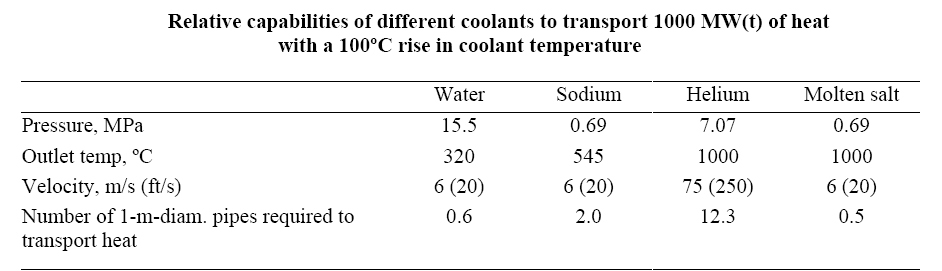
heat capacity is 4540 kJ/m3, which is
similar to that of water, more than four times that of
sodium, and more than 200 times that of helium (at
typical reactor conditions). 2. The
eutectic mixture is slightly greater than 50% BeF2
and has a melting point of 360°C (680°F). -
The fuel for the MSRE was
LiF-BeF2-ZrF4-UF4
(65-30-5-0.1), the graphite core moderated it, and its secondary coolant was
FLiBe (2LiF-BeF2), it operated as hot as 650 °C (1,200°F) and
operated for the equivalent of about 1.5 years of full power operation."
http://en.wikipedia.org/wiki/FLiBe
http://en.wikipedia.org/wiki/Lithium_fluoride
http://en.wikipedia.org/wiki/Beryllium_fluoride
http://en.wikipedia.org/wiki/Zirconium_fluoride
http://en.wikipedia.org/wiki/Uranium_tetrafluoride
Some other designs
(sometimes called molten-salt cooled reactors) use it as
coolant, but have conventional solid
nuclear fuel (i.e., TRISO pebbles) instead of
dissolving it in the molten salt.
Another, commercially available, heat transfer salt
is "HITEC." It was suggested for use in the third loop of the
EBASCO-designed supercritical steam power plant.
Several issues
touched on in the LFTR forum's cost thread invite Nuclear Green
posts, but one by Chemical Engineer Kim L Johnson
via NuclearGreen
- Charles Barton 9/2/11
The third part of my interview Q&A with Sherrell Green
focused on questions concerning the future of nuclear
technology. My father had been a pioneer in research on Liquid
Chloride Reactor technology in the 1950's. Sherrell Greene
mention LCR development during out preinterview, so I wanted to
ask him some follow up questions. The LCR is a potential
competitor to the Liquid Metal Fast Breeder Reactor, but it is
not clear if itsadvantages would out wight its potential costs.
Sherrell notes that,
The environment
in today’s nuclear energy enterprise is hostile to innovation.
This is undoubtedly the case, and the consequence of our
unwillingness to take risks on new concepts in nuclear power are
ominous. for our country are ominous. Continuing a business as
usual pattern is likely to bring national economic and
environmental failure, but it is not clear what it is we should
be doing.
34. Do any Liquid Chloride Salt formulas hold potential
advantages in comparison to Flibe (The lithium fluoride (LiF)
and beryllium fluoride (BeF2) mixture, often referred to as the
preferred carrier/coolant salt formula for MSRs?
(No tertiary salt such as HITEC should be needed in
this application.)
________________________________________________________________________________________
Control Room
Electrical Room
Instrumentation Room
Maintenance Shop
Toilet, Shower, Locker Room
Lounge - Conference Room
Office Room
Diesel Engine Room
Salt Storage Room
Thorium Storage Room
General Storage Rooms
Diesel Fuel Storage Room
http://www.dow.com/heattrans/prod/synthetic/dowtherm.htm Dowtherm "A"
(15 to 400°C) might be considered a test stand-in for FLiBe for early heat exchanger experiments.
(
http://fluorine.sites.acs.org/apps/profile/58116851/ )
MSR - Johnson, Kim L - Fluorine Chemistry - 760.jpg
is down right pregnant. Johnson writes,
"I'm
a chemical engineer who has been working to develop industrial
Fluorides for many years and have assembled lots of online
documentation for the benefit of Lftr and the like.
If you have any significant interest in Fluorides, structural
materials for Fs and in which forms of whatever elements are
best for the Lftr bath & containment, I would be happy to send
you lots of link. Sadly however, I can no longer post
important details Freely. Serious Foreign competition
could very well, in a few years' time, leave the US so far
behind in our own Fluoride-Energy tech we'd never recover
economically. Fortunately, the very successful efforts of
TEA & other "T Com" leaders -- fruit we shall soon see in the
Senate & elsewhere -- should shortly enable guys like you,
(hopefully) Lars, and many others to develop Thorium-enabled
technologies full time (*just* getting off the phone with this
effort's champion) !"
Sherrell Greene on Liquid Chloride Reactors
Most of the chloride-based salts
don’t perform well in the thermal spectrum. Corrosion management
is more demanding than the fluoride salts. LiF-BeF2 (FLiBe)
mixtures are very attractive from the nuclear, thermal,
chemical, and thermo-mechanical standpoint. But with you have a
tritium production issue, a lithium enrichment cost issue, and a
beryllium occupational exposure issue to deal with. All of that
drives up the cost. George Flanagan and David Holcomb at ORNL
have recently evaluated some of these issues. They conducted an
initial screening of LCR salt options, and developed a pre-pre-
conceptual concept for a LCR. MIT and a few others have also
done work in this area.
35. Do any Liquid Chloride
Salt formulas have the potential of being technically
competitive with Flibe, but at a lower cost?
Again, I think you will want to
consider chloride salts for harder-spectrum systems. So it’s a
different application. That’s said, I don’t think we know enough
to answer the question. I am pessimistic there is a chloride
salt that can match FLiBe from an integrated performance
perspective.

The table above gives an idea as to the range of temperature expected from non-intercooled, non-reheat, single shaft turbine engines. The centrifugal compressor has an isentropic efficiency of 80% and a pressure ratio of 4 to 1 while the axial-flow turbine has an isentropic efficiency of 85% and a pressure ratio of 3.8 to 1. Ambient air temperature is specified at 32-degrees C or 90-degrees while the compressor outlet temperature has been calculated at 424-degrees F. The part-load fan and combustion induction fan are specified at pressure ratios of up to 1.1 to 1.
The range of combustion temperatures reflects the range of fuel being used, from gasified biomass having high moisture content to anthracite coal. Gasified coal typically combusts near 2100-deg F.
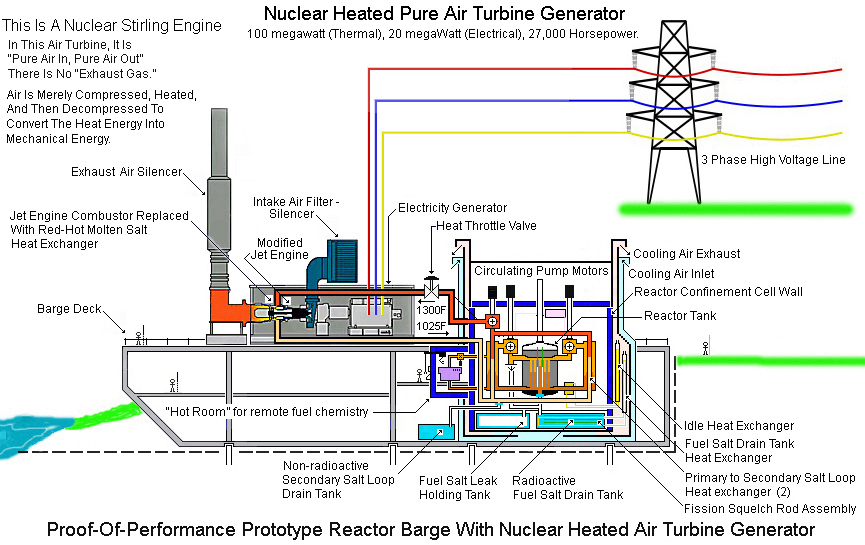
The X211 was a relatively large turbojet engine of straight conventional layout, save for the combustion chamber being replaced with a heat exchanger. It featured variable-stator compressors and an afterburner. A single nuclear reactor was intended to supply heat to two X211 engines.
http://www.poweronsite.org/ Cogeneration
Association
http://www.energysolutionscenter.org/ Gas
Association - GE has some interesting turbines -
organic, etc.
http://www.poweronsite.org/Tutorial/CombTurbine.htm#Overview
Good paper, good source.
http://www.ecotera.com/tec.htm External
combustion turbines.
http://www.btola.com/
Creative Power Solutions - Brent Gregory, President President at Creative Power Solutions Phoenix, Arizona Area | Utilities Current: Partner at Creative Power Solutions, President at Creative Power Solutions (USA) Past: Consulting at Siemens Energy, Senior Staff Engineer at GE Energy, Manager at GE Education: Rolls-Royce - Engineering Apprenticeship Summary: Engineering Manager
Creative Power Solutions (Usa), Inc in Scottsdale, AZ is a private company categorized under Turbines Manufacturers. Current estimates show this company has an annual revenue of $470,000 and employs a staff of approximately 3. Companies like Creative Power Solutions (Usa), Inc usually offer: Olympian Generator Sets, Motor Generator Sets, Capstone Turbine, Steam Turbine Generator Set and The Partisan Turbine.


